

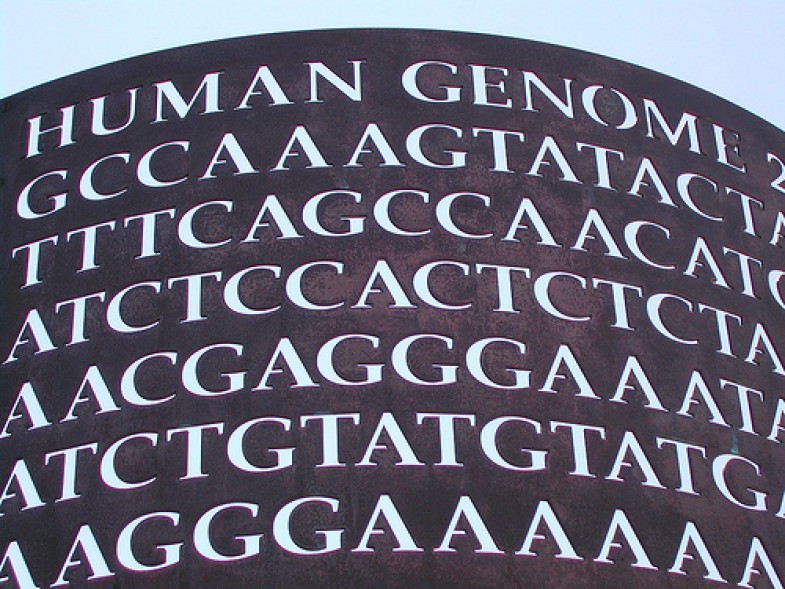
There is something ethically distasteful about anyone “owning” our DNA, yet that’s exactly what the U.S. Patent and Trademark Office does. It grants patents in genes (among other things). With the sanction of the U.S. Supreme Court, which recognized patents in lifeforms in 1981, one-fifth of the human genome is now privately owned.
The implications of this trend, which has been accelerating for the past few decades, are sobering. Pharmaceutical and biotech companies can legally assert exclusive control over who may study, test or look at a gene, lest such activities interfere with the profit potential of their patent.
Photo by Dollar Bin, via Flickr, licensed under a Creative Commons Attribution, NonCommercial license.
Granting property rights in genes is supposed to be a necessary incentive to spur medical innovation and treat disease better. In practice, it is now clear that exclusive patents on genetic knowledge are an arcane form of monopoly. Not surprisingly, this means that patent holders have the ability to thwart competitive research, squelch innovative products and charge exorbitant prices. The end result, as some women are discovering, is dangerous to their health.
Myriad Genetics, a private company in Salt Lake City, owns a patent on breast cancer genes known as BCA1 and BCA2. Women who have these genes have a significantly higher risk of contracting breast and ovarian cancer. But because of its patent, Myriad is the only source of diagnostic testing for the genes.
Myriad is also the only research center that is allowed to study the BCA genes. Everyone else needs formal permission, which may require a license fee. If you happen to be a medical researcher at Harvard or UCLA or an illustrious European medical center, don’t bother trying to study these genes. It would violate Myriad Genetics’ patent.
And if you want to get a diagnostic test to see if you have BRCA gene mutations, again, you can only go to Myriad Genetics. Its BRCAnalysis® test costs $3,000.
The problems of patenting genes are not confined to breast cancer. Across the board, gene patents have gummed up scientific research and diagnostic testing by erecting artificial fences on knowledge and what can be done with it. The result: delays, restrictions and outright bans on certain forms of research. Certain forms of medical innovation are simply off-limits. The harm may sound abstract, but in fact, it hurts real people who are suffering from certain cancers or illnesses that researchers might be able to treat — if only they could share their knowledge and collaborate.
Now, finally, a significant legal challenge is being mounted to the whole notion of patenting genes. On May 12, 2009, the ACLU and the Public Patent Foundation, a not-for-profit organization affiliated with Benjamin N. Cardozo School of Law, filed a lawsuit charging that patents on two human genes associated with breast and ovarian cancer are unconstitutional and invalid.
The lawsuit has been brought on behalf of four scientific organizations representing more than 150,000 geneticists, pathologists, and laboratory professionals (the lead plaintiff is Association for Molecular Pathology). The case also represents individual researchers, breast cancer and women’s health groups, genetic counselors and individual women. The defendants in the case are the U.S. Patent and Trademark Office, Myriad Genetics and the University of Utah Research Foundation, which hold the patents on the BRCA genes.
The ACLU explained the reason for its lawsuit:
The patents granted to Myriad give the company the exclusive right to perform diagnostic tests on the BRCA1 and BRCA2 genes and to prevent any researcher from even looking at the genes without first getting permission from Myriad. According to the lawsuit, such monopolistic control over these genes hampers clinical diagnosis and serves as a disincentive for research because Myriad not only has the right to enforce its patents against other entities but also has the rights to future mutations discovered on the BRCA2 gene. The gene patents are also illegal under patent law because genes are “products of nature.”
“Patents are meant to protect inventions, not things that exist in nature like genes in the human body,” said Chris Hansen, a staff attorney with the ACLU. “Genes isolated from the human body are no more patentable than gold extracted from a mountain.”
The role of Myriad Genetics in stifling breast cancer research received some exposure recently on the PBS POV series. A film called In the Family, http://www.pbs.org/pov/inthefamily/film_description.php profiled woman who had a family history of breast cancer but could not afford the BRCAnalysis® diagnostic test.
In trying to deal with her own hereditary cancer risks, filmmaker Joanna Rudnick said:
“Over the last eight years, I have pleaded with doctors and scientists to tell me more about my odds of developing cancer. Their answers are always the same: ‘One day, we will understand how other genes, so called ‘modifier’ genes, increase or decrease your risk.’ Genes don’t act in isolation. How can we find out how BRCA works with other genes if Myriad’s patent limits this essential research?”
When the filmmaker went to Myriad’s headquarters, she interviewed the founder and chief scientific officer of the company, Dr. Mark Skolnick. “The lab was beautiful and state of the art,” she reported, “but Skolnick’s answers surrounding the fixed pricing, ethics and detrimental consequences of gene patenting were unsatisfying and dubious (“People don’t complain about having patents for the iPods,” he told me), leaving more questions than answers and leading to where we are now with the ACLU challenge.”
Things weren’t always this way. In a famous incident in the 1950s, journalist Edward R. Murrow asked Dr. Jonas Salk, inventor of the polio vaccine, “Who owns the patent on this vaccine?” Salk replied, “Well, the people, I would say. There is no patent. Could you patent the sun?”
In a way, lawyers have found a way to patent something else as elemental as the sun – and our courts and legislatures now sanction this ethical offense against the commons. Here’s hoping the ACLU prevails. You can sign a message of support for the ACLU lawsuit here.