


At a time when city parks are suffering deep budget cuts, leaving recession-strapped American families with fewer choices for fun, there’s growing evidence that first-class park facilities may be a key to economic revitalization.
Ambitious park projects in struggling places like St. Louis, Detroit and central Houston are “ bringing urban centers back to life,” according to a recent headline in the “Washington Post”: http://www.washingtonpost.com/wp-dyn/content/article/2010/07/30/AR2010073003588.html
The jewel of downtown Detroit, which has sparked more than a half-million dollars of investment in adjoining blocks is “Campus Martius”:http://www.pps.org/motorcity/ —a pocket park that had been reduced to little more than a concrete traffic island over decades of street widening in the Motor City. In 2004, however, it was transformed into a piazza of sorts by narrowing nearby streets, adding a fountain, café, landscaping, wintertime ice rink and a stage where more than 125 events are staged each year. The result: A vital truly public space that lured the Compuware computer firm and its 4000 employees from suburban Detroit to the heart of town.
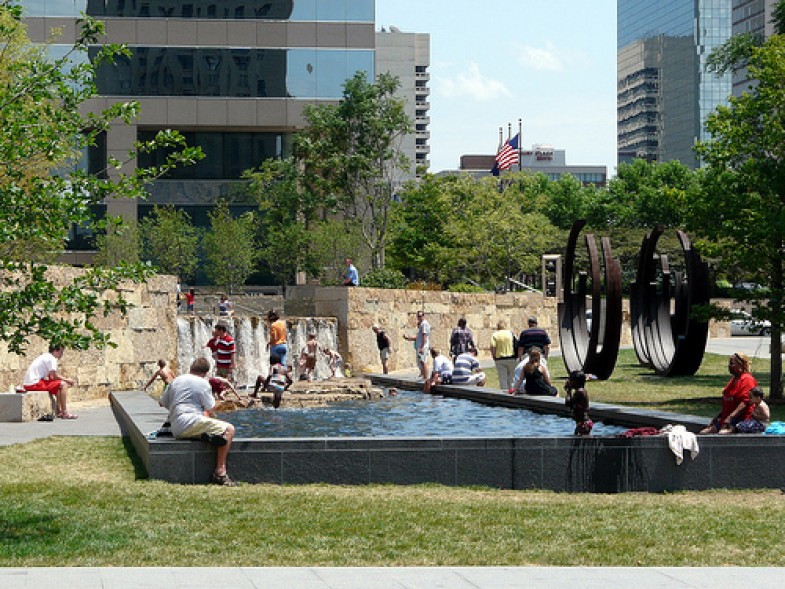
In St. Louis, “Citygarden”:www.citygardenstl.org”—two blocks of sculpture, lawns, fountains, wildflower gardens and strolling crowds near the St. Louis Arch that opened last year—has transformed abandoned warehouses in the neighbohood into fashionable lofts.
Two parking lots in a neglected corner of downtown Houston were tore up to create “Discovery Green”:http://www.pps.org/houstonpark/ a 12.5 acre town square that brings a nucleus of urban energy to a sprawling city with performances, cafes, a pond, bocce court and a bookmobile. The site, opened in 2008 in the midst of the recession, has attracted a hotel and Houston’s first apartment tower in decades. In addition to downtown workers, out-of-town visitors and daytrippers from the suburbs, Town Green is enjoyed by residents of nearby low-income neighborhoods.
The lesson from these three parks is that investing in public space— the original sense of the commons—is a boost not a drain on local budgets in these challenging economic times. It’s a smart move that serves both local residents and prospective business ventures. That’s a win-win in anyone’s book.